5. Rolling the snowball
on
|
""There is a contemporary form of violence to
which the idealist fighting for peace by nonviolent methods most
easily succumbs: activism and overwork.
The rush and pressure of modern life are a form, perhaps the most
common form, of its innate violence. To allow oneself to be
carried away by a multitude of conflicting concerns, to surrender
to too many demands, to commit oneself to too many projects, to
want to help everyone and everything is to succumb to violence.
More than that, it is cooperation in violence.
The frenzy of the activist neutralises his or her own work for
peace. It destroys the fruitfulness of one's work, because it
kills the root of inner wisdom which makes work
fruitful."
Thomas Merton. |
5.1 Forming an "affinity
group"
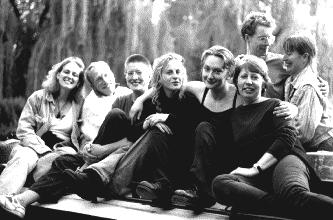 We
recommend that you do your action as part of an affinity group.
An affinity group is a small group of up to about 15 people who
come together to take nonviolent action. They get to know each
other's strengths and weaknesses through working together and by
making a commitment to supporting each other they can build up
trust. This "affinity" makes preparations and decision making
easier and sustains everyone through the challenges of taking
nonviolent action.
We
recommend that you do your action as part of an affinity group.
An affinity group is a small group of up to about 15 people who
come together to take nonviolent action. They get to know each
other's strengths and weaknesses through working together and by
making a commitment to supporting each other they can build up
trust. This "affinity" makes preparations and decision making
easier and sustains everyone through the challenges of taking
nonviolent action.
If you have more than fifteen you might want to consider dividing
into two groups. (See also section 5.11 on roles). You may
already be part of a group who would like to join the campaign.
If not, you could start one with friends or people with whom you
know you can work well. Otherwise, you could organise a public
meeting and invite people to form a group at the end of the
meeting.
5.2 Group
preparation
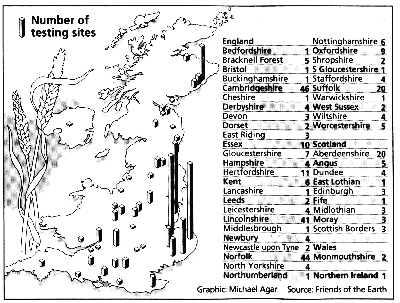 The first
step is for everyone to read the parts of the handbook which are
relevant for them. We recommend that everyone reads sections 3,
4, 5 and 6.
The first
step is for everyone to read the parts of the handbook which are
relevant for them. We recommend that everyone reads sections 3,
4, 5 and 6.
Taking nonviolent action can be difficult because we are
challenging our own obedience which constrains our beliefs about
what is possible. Get to know each other. Talk about how you got
involved, the steps which led you this far, your hopes and fears,
best and worst case scenarios. Use your time to build up trust
and friendship within the group. Discuss your concerns and
worries - of doing the action, of possibly getting arrested,
being injuncted or sued for damages, being in the media
limelight, how to cope with the responsibility that goes with
becoming more powerful. Start making practical preparations where
possible. For example, in case you are sued for damages (see
section 6.6 for more details), the best way to keep all your
assets is to give them away! For useful reading on group process
see appendix 5.2.
Establish how much time each person has to contribute; it is
important to be realistic and honest about what you can offer so
that the group can look for more people if necessary. Be aware
that your commitment may be needed for quite some time, before,
during and after the action with varying levels of
intensity.
5.3 Making decisions
Consensus decision making (when everyone in the group agrees with
the decision) is a good way to ensure that you go into a risky
situation with everyone feeling good about the decisions made.
However, there are times when consensus is not appropriate;
especially when you are short of time, you have yawning
differences in your group, when you don't have enough
information, when the issue at hand is trivial. At times like
these, defer to experience, take a vote, or for trivial matters -
flip a coin. See appendix 5.3 for a guide to consensus decision
making.
5.4 Timelines
The genetiX snowball actions can happen on the first and third
weekends of every month (see section 3.2.3). You will need to
consider when is the best time to remove the crops (see appendix
5.5.3). You may also want to invite a trainer for a nonviolent
action training session or join in a training in your region.
Work out a plan to get more people involved and consider re-
visiting the same site on a regular basis. Create a detailed
timeline to help you get your preparation work completed with
plenty of time. When we evaluated the first snowball action the
point which came out most strongly was that we always
underestimated the amount of time we would need to complete any
task.
5.5 Choosing your release
site
One of your most urgent tasks to be done - partly because it may
take you considerable time - will be to choose and locate your
release site. See appendix 5.5.
5.6 Writing to the
farmer
See also below section on choices to make.
The minimum degree of openness required for genetiX snowball is
to write to the farmer before the action. Writing as an initial
contact may avoid making the farmer feel threatened, as s/he
might be by a knock on the door, or a phone call. Your letter to
the farmer could refer to the general genetix snowball letter
which has already been sent (see appendix 4.1) and go on to
introduce yourselves as a genetiX snowball group. Explain that as
a small group you are planning to do an action on his/her land;
remember to explain that you will be nonviolent. You do not
necessarily need to give the date or time of your action
(remember also that whoever signs the letter could be arrested or
injuncted before or during the action). We recommend that you
give a contact address which will not risk yourselves or anyone
else with whom you live (it is possible that companies may send a
private investigator to monitor your movements). If you are not
sure which site you will choose then you could write to all those
farmers connected to the most likely sites.
5.7 Choices to make
We recommend that you explore the following issues in your group
and come to consensus on what you will do. Please let us know
what you decide and how it goes so that we can advise others
based on your experiences.
5.7.1 Becoming even more
open
We were very cautious about giving out details of our action
beforehand. Our action was the first and we had very little idea
what would happen. We had to be ready for nothing at all or all
being arrested and remanded for conspiracy before we could do our
action. We also had a high media profile which was an extra
stress over the need to come up with the goods.
We hope that groups will experiment with pushing the frontiers of
openness out much further than our minimum ground rule. You could
contact us to find out what other groups have tried out, and
please let us know what you have tried yourselves and the
results. The following is a series of possibilities you might
want to explore:
5.7.1.1 Giving the farmer more
details beforehand, or not
Preparation for the launch snowball action included letters to
all farmers with GM release sites. We did not write a special
separate letter to the farmer who was hosting the site where we
did our action, since he had only just received the general one.
One of us did go to visit this farmer and discussed the issue of
GM crops, but this was before he had received our letter and
before he knew anything about genetiX snowball.
There are pros and cons of giving the farmer more than minimal
details before the action, such as the date and time, or of
asking to meet with the farmer. You may get a chance to find out
a bit about the farmer's circumstances. We changed our initial
chosen release site after inadvertently meeting with the owners
of a small garden centre which had a release site (which we were
checking). They were both older people and seemed to be very
upset and threatened by the possibility of the action happening
on their land. The situation was made worse by the fact that the
release site was close to the farm buildings which meant that
they might feel personally threatened. We strongly recommend that
you avoid these situations; it may be difficult to reassure them
that we are peaceful and we don't want people to feel afraid.
If the farmer is likely to be aggressive it may help to reassure
him/her if s/he knows what to expect. People are usually violent
because they are afraid, and people are often afraid when they
don't know what is happening. On the other hand the farmer may
well perceive advance notice of the action as a threat and worry
about what might happen.
The farmer may try to prevent you from doing the action. S/he is
most likely to tell the company since it is their release site
and may also inform the police. It is also possible that the
farmer will be there with his gun and his dog!

5.7.1.2 Giving the company more
details beforehand, or not
All the companies responsible for GM release sites in Britain
have been sent letters from genetiX snowball (see appendix
4.1). Informing the company of your action would give the
advantage of creating more openness and give you an opportunity
to ask them again to remove the GM crops themselves.
You could ask to meet with the company beforehand to explain why
you think their practices of genetically modifying plants are
wrong. You could also discuss alternative methods of food
production which are ecologically sustainable, safe and secure.
In this case you could all be injuncted at the meeting or you may
come under pressure from them to change your plans in a "let's
talk whilst we continue to contaminate" situation.
The farmer is likely to inform the company, so writing a letter
to the company giving the same amount of information as to the
farmer may not change the circumstances of your action very much.
However, if you give any more information, such as the date and
location, the company may hire their own security guards, inform
the police or serve an injunction on you before, during or after
the action.
5.7.1.3 Giving the police more
details of the action, or not
The police are already aware of the genetiX snowball campaign. We
wrote to Thames Valley Police (see Appendix 4.1 for our letter)
before our action and we also responded to a telephone call. We
asked them to investigate the crimes we believe companies are
committing, but so far they have not taken legal action against
the biotechnology companies. Their attitude during our action was
to listen to us first, they gave all the appropriate warnings
before arresting us and gave us opportunity to leave of our own
accord. They were polite and reasonable and did not use any force
at any time. They reported our action to the press as a peaceful
action.
We feel there is no need to give the police any further details
since we have already informed them about the crimes the
biotechnology companies are committing. However, there is an
argument for letting them know the date and location; especially
if you fear the farmer may be aggressive, in which case you might
want the police to be there! On the other hand the police may
arrest you for breach of the peace if the farmer is being
violent. Yes, they can do this!
The police may try to arrest you as you are arriving and prevent
you from reaching the site; however the intention to remove the
crops has an importance of its own and if you are released later
without charge, then you can simply return and try again.
5.7.1.4 Some additional openness
possibilities
- you might want to sign letters with all your names (you may
all be risking an injunction from the company);
- you could give out statements of intent before the
action.
5.7.2 How many "pull-ups" can you
do?
To be a part of the genetiX snowball each individual can pull up
anything up to, but no more than, 100 plants. This limit has been
set to protect participants and to encourage a sense of unity in
our actions. If we all pull up a similar numbers of plants, we
should all be treated equally and no 'unspoken hierarchies' of
action or of our abilities will develop. The genetiX snowball is
designed so that everyone can take part on an equal basis and so
encouraging some people to do more than others could manage would
be to go against its principles. In addition, limiting the number
of plants we pull up at any one time allows more room for
dialogue and opportunities for the companies or farmers to pull
up the GM plants themselves.
Arguably, genetiX snowball could be effective in two ways: (a)
literally uprooting all the GM plants, or (b) symbolically
uprooting all the GM plants. The former could be effective simply
because all the plants are gone which in itself has a powerful
symbolism. The latter could be effective because the symbolism
brings the issue into the public domain; it is here, not in the
field, that the action can realise its potential power. Whichever
you believe, both methods are possible. genetiX snowball is about
ordinary people taking responsibility and encouraging others to
do the same; so if you want to get all the plants out of the
ground just get more people to join in!

'Test site' at Model Farm, Oxfordshire, scene of the
first
genetiX snowball on 4th July 1998. Photo Hugh
Warwick
We recommend that within your group you discuss what each member
feels comfortable doing. You may also want to consider whether it
is best if you all pull up the same number of plants so that the
risks for all are equal. Here are some ideas of what you or your
group could do at the site within the maximum limit of 100
plants:
- Digging up one plant has a powerful symbolism. Digging up a
small number of plants will be over very quickly and will not
allow much ritual. In practice it might be difficult to just pull
up one when there is a whole field in front of you!
- You could use a symbolic number to make reference to an
event.
- You could create a "crop circle" or an X shape for added
symbolism.
- Increasing numbers of plants each time; for example, the
first action is one plant each then a declaration to do a ten
fold increase each time. ie 1, 10, 100. This would be very
reasonable since you are allowing time for your opponent to
change before you up the stakes.
5.8 Getting support
You do not need to be invincible, have all the answers or re-
invent the wheel. Contact the genetiX snowball office if you have
any problems or need help with anything. There are many other
groups working on the issue of GM crops and/or are experienced in
either campaigning or taking nonviolent action. You could get
help with your work from other campaigns (see Appendix Contacts &
Resources), for example, briefing sheets on GM crops and up to
date information.
5.9 Practising
nonviolence
 You can
get very good information about this without us duplicating what
has already been done, see appendix 5.9. We strongly recommend
that you follow up our references and organise a nonviolence
training for your group. Turning the Tide is a Quaker
organisation which specialises in nonviolence training for
actions. They do trainings free of charge if you cover their
expenses and they have trainers throughout Britain.
You can
get very good information about this without us duplicating what
has already been done, see appendix 5.9. We strongly recommend
that you follow up our references and organise a nonviolence
training for your group. Turning the Tide is a Quaker
organisation which specialises in nonviolence training for
actions. They do trainings free of charge if you cover their
expenses and they have trainers throughout Britain.
5.10 Reaching into your
community
This is more democratic than a small isolated action which does
not make reference to its locality. Some people may not feel able
to form a snowball group but will be very keen to help in other
ways; you might be able to get help with legal advice, banner
making, transport, child minding, making food, conflict
mediation. Local people who may be interested in supporting your
group include organic farmers, allotment associations, churches
and temples, women's groups, health food shops and grocers, local
'green' groups. Tell your friends and colleagues, put up posters,
distribute leaflets, hold a meeting, organise a debate - use your
imagination ....
You will find a poster and leaflet design which you can photocopy
to use locally in the appendix 5.12.
5.10.1 Generating dialogue and
debate
In preparation for the action you could write some letters to
voice your concerns about GM. You can get a list of addresses
from the genetiX snowball office. You could arrange to meet with
representatives of the company responsible for the release, your
local supermarket manager, your MP. These letters and meetings
will open dialogue with others in a position to influence the
issue and give space for them to use their power to stop the GM
release site experiments. At least one farmer, in Wiltshire, has
cancelled a proposed contract to plant GM crops after hearing
about the dangers.
Public meetings and debates are an excellent way of informing
people about the arguments around the issue of GM. You could
invite speakers from the various campaigns against GM and from
the GM companies. Create displays detailing arguments against GM
for people to wander around.
5.11 Roles to share
out
There are a number of tasks which you will need to cover before,
during and after the action. Ideally you should have at least
five people who are doing essential support work i.e. not doing
the hands-on decontaminating. Some support tasks need the
attention of at least one person, others can be doubled up. The
most likely roles for arrest are obviously the decontaminators;
the support members who will be on site are also possible
candidates; whereas support members who are off site should be
almost completely safe.
- People to do the decontamination work of pulling up the GM
plants. We recommend a minimum of two people. Four people is a
good number because you can pair up and work together.
Decontaminators will need to write their statements explaining
why they intend to take action, what they intend to do and how
they will do it - see section 3.2.3.
- Someone to watch and make notes of how the action is carried
out and what happens. If anyone is arrested, this person could
act as a witness in court and the notes could be very valuable.
You can use these notes if they are signed and dated on the day
of the action. See appendix 5.11 for guidance on observing
actions.
- Someone to take photographs and film the action for use by
the media.
- Someone to liaise with the police, to explain what is
happening, to reassure and calm any potentially difficult
situations.
- Two people (preferably a man and a woman) to inform the
farmer that the action is about to happen or is happening.
- Someone to support people who have been arrested, to wait at
the police station for their release, send them newspapers,
chocolate and notes of support whilst they are being held.
- Someone to stay away from the action and be a contact person
near a phone in order to do press work. It is helpful if the
group can keep in contact with this person via a mobile phone and
keep them updated about what is happening. This person can also
contact a solicitor of the group's choice if there are any
arrests and contact anyone whom the decontaminators want to be
kept in the picture.
- Everyone who hasn't been arrested should be prepared to give
support, both emotional and practical, to anyone who has,
throughout the court hearings and through any situations which
arise from these. See section 6.1.8 for further
details.

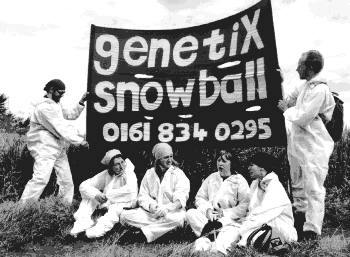
Support Roles, though outside the media spotlight are crucial
to a successful action.
Shown left-to-right: Film maker, Police Liaison, Farmer Liaison,
Action Observer, Photographer.
Second genetiX snowball 18th July 1998. Photo: Paul
Kingsnorth
5.12 Preparing your
equipment
All the equipment you take to the action is an opportunity to
give a message about your action. You could make a banner or some
flags (which are quick and easy to erect). Avoid tools which
might give a scary message - like scythes. Brightly coloured
headscarves or hats look more friendly than hoods. We decorated
our protective clothing and hand tools. We didn't wear masks
because we thought they made it very difficult to communicate
with people.
See appendix 5.12 for a complete checklist list of equipment and
where to obtain things.
5.13 Media
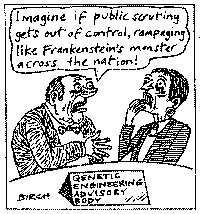 See
George Monbiot's media guide in appendix 5.13 and press releases
from the first snowball action in appendix 4.3.
See
George Monbiot's media guide in appendix 5.13 and press releases
from the first snowball action in appendix 4.3.
5.14 The scene of their
crime
Before the day of the action work out a programme for the day
which includes when, how, who and what will happen. Start by
going through a checklist of what you need to take (see appendix
5.12), have all your transport details fine tuned and give some
thought to each stage of the action.
These plans will be made according to an ideal scenario. However,
it is worth going through some contingency plans. There are so
many possible scenarios that the best way to deal with them all
might be to work out a system for emergency decision making.
Practice making decisions quickly and role play some scenarios.
What will you do if the bus doesn't show up, if somebody in a
crucial role cannot make it at the last minute, if the police are
already there when you arrive, if the farmer has harvested the
crop?

Prepare for action: gloves, protective clothing
and spade.
Photo: Nick Cobbing