In this section...A5.3 Making decisions: A guide to consensus decision making A5.5 Choosing your GM release site A5.5.1 What is a deliberate release A5.5.1.1 Small scale release sites for scientific research A5.5.1.2 Agronomic testing A5.5.1.3 NIAB testing and commercial certification A5.5.2 How to locate a release site A5.5.2.1 The GMO Public Register A5.5.2.2 Notification in the local press A5.5.2.3 Consent Schedules A5.5.2.4 Contacting the biotechnology company A5.5.2.5 Check out a Website A5.5.2.6 Visit the farmer/release site A5.5.3 Crop Identification A5.5.3.1 Oil seed rape A5.5.3.2 Sugar beet A5.5.3.3 Maize/Corn A5.5.3.4 Potato A5.9 Practicing nonviolence A5.10 Reaching your community: Sample poster & leaflet A5.11 Roles: Briefing for Action/Legal Observers A5.11.1 Why observe? A5.11.2 How to observe A5.11.3 The Law and action/legal observers A5.12 Preparing your equipment: Check- list A5.13 An activist guide to exploiting the Media |
In a parliamentary reply to the MP for Totnes, Ms Angela Eagle on behalf of the Minister for the Environment stated that: "Currently there are 64 experimental trials of GM crops in progress covering a total of approximately 841 acres [N.B. each trial takes place at a number of sites, hence the figure of 300 test sites above] .... The majority of the experimental trails are for oilseed rape (27), sugar beet (16), and potatoes (14), although GM wheat (3), maize (2) and chicory (1) are also grown."
On 21 July the Court of Appeal ruled that the Government had acted unlawfully in dispensing with the statutory requirements for entry of new seed types onto the national seed list. The Government will now have to reassess the whole seed list process delaying the introduction of commercial GM crops by up to two years.
The GMO Register is a shameful chaos of inaccuracies. This makes it very difficult for people to get clear and accurate information on sites and you should take all reasonable measures to confirm the sites.
For example, on the second genetiX snowball action, on Manor Farm near Banbury, we discovered that the release site was not GM oilseed rape as the GMO register had stated. Three years previously the farmer had unknowingly planted a GM oil seed rape crop; as soon as he realised he broke his contract. He told us that he does not believe in interfering with nature and will not allow any further GM releases on his land. We apologised for disturbing him and explained that the GMO Register lists his land as having a GM release site.
The register contains the details of each application for the deliberate release of GMOs as follows:
Reference Number:- this is the unique number assigned to each application, e.g. 94/R14/1. The number is made up of three parts: the first part is the year the application was granted, in this case 1994; the second is a reference number for the particular applicant, in this case R14 is the Scottish Agricultural College; the third part is the application number for that applicant, in this case it is the college's first application.
Receipt date :- the date the application was received by the DETR Biotechnology Unit.
Applicant :- the applicant's name and address
Organism :- the crop type and what genetic modification has been made to it
Purpose :- the reason for the field trial, most trials are to test for agronomic performance, very few assess ecological impact.
Release dates :- the dates between which the GMO can be released into the environment i.e. the dates between which the GM crop can be grown.
Release site(s) :- The location of the actual release. Sometimes there will be a list of sites here, and sometimes the years it will be released as well. Sometimes there is an Ordnance Survey grid reference number, but this may be for the farm, rather than the actual release site. Often there is a rather unhelpful sentence saying something like, "further details of the sites scheduled for 1998-9 will be made available at a later date," or, "further sites will be notified when they are confirmed."
Release area(s) :- a rough guide to the size of the site, in m2, hectares or acres.
Consent date :- the date on which the Secretary of State gave permission for the release.
Conditions :- these are things that the applicant must do in order to comply with the terms of the consent. This generally includes 'notification/advertisement of details of locations of all release sites and reporting.' This means that the applicants are legally obliged to publish a notice giving information on the whereabouts of each new sowing of GM crops in the local paper of the affected area (see below). The applicants are also required to inform the Advisory Committee on Releases to the Environment (ACRE) if anything unexpected happens to their crop. The conditions almost always end with, 'see consent schedule' (see below).
Many of the entries in the register are already several years old and do not contain up to date information on the whereabouts of the current release sites. Many entries in the register state 'further sites will be notified when they are confirmed'. The sites may well be confirmed at some later date but that does not include updating the GMO register. This makes it difficult to tell whether a site still exists without going to look at it, and even this might not tell you very much. The register provides a list of sites that have been used in the past, these may well be used again, indeed some of the trials may be fixed in one location for their duration.
| Last entries added 25/3/98
GMO PUBLIC REGISTER - INDEX | |||
| Reference: | 97/R22/9 | ||
| Receipt Date: | 3 March 1997 | ||
| Applicant: | Monsanto plc Crop Protection PO Box 53, Lane End Road High Wycombe, Buckinghamshire HP12 4HL | ||
| Organism: | Spring oilseed rape modified with Roundup Ready genes (glyphosate tolerance) | ||
| Purpose: | The proposed experimental programme is based on progeny of spring oilseed rape plants containing the Roundup Ready genes (tolerance to glyphosate). The general purpose of this experimental programme is to assess the performance of Roundup Biactive applications to control weeds in a spring oilseed rape crop and generate the necessary data for the registration of this Roundup Biactive use. There will also be small scale plots in order for the technology to be demonstrated to selected groups. | ||
| Release Dates: | From 1 March 1997 to 30 September 2001 | ||
| Release Sites: | Throws Farm Stebbing Great Dunmow Essex PL 578263 |
Manor
Farm Wilton Malborough Wilts SN8 3SP SU 263613 |
Worsley Brocklesby N. Lincs TA 103076 |
| Herbicide Registration trials Ibstick Grange Farm Pretoria Road Ibstock Leicestershire SK418098 |
Firtree Farm Fillongley Nr. Coventry Warwickshire SP 285875 |
Lodge Farm Kings Newton Derbyshire SK 397264 | |
| Tib Hall Farm Kingsbury Nr. Tamworth Staffordshire SP 228933 | |||
| Release Areas: | Not exceeding 0.5 Ha | ||
| Consent Date: | 7 April 1997 | ||
| Conditions: | Yes: notification/advertisement of details of locations of all release sites and reporting (see consent schedule) | ||
You can get details of the sites closest to you direct from the genetiX snowball office. Otherwise you can order a copy of the GMO Public Register from:-
The Biotechnology Unit, Department of the Environment, Transport and the Regions, Ashdown House, 123 Victoria Street, London, SW1E 6OE. Tel: 0171 890 5275/5277 Fax: 0171 890 5259.
Or view the GMO public register at the following locations:-
ANGLIAN REGION:-Cambridgeshire, Essex, Lincolnshire, Bedfordshire, Bucks, Northamptonshire, South Humberside, Suffolk The Environment Agency, Anglian Region ,Public Register Section, Kingfisher, Goldhay Way, Orton Goldhay, Peterborough, PE2 5ZR
MIDLANDS REGION:-Derbyshire, Hereford and Worcestershire, Leicstershire, Notts, Shropshire, Staffs, Warwickshire, West Midlands. The Environment Agency, Midland Region, Public Register Section, Olton Court, 10 Warwick Road, Olton, Solihull, Midlands, B92 7HX
NORTH EAST REGION:-Cleveland, Durham, Humberside, North Yorks, Northumbria, South Yorks Tyne &Wear, West Yorks. The Environment Agency, North East Region, Public Register Section, 1st Floor, Stockdale House, Headingley Business Park, 8 Victoria Road, Leeds LS6 1PF
NORTHERN IRELAND the Department of the Environment(NI), Environment Service, Calvert House, 23 Castle Place, Belfast BT1 1FY
NORTH WEST REGION:-Cheshire, Cumbria, Greater Manchester, Lancashire, Merseyside The Environment Agency, North West Region, Public Register Section, PO Box 12, Richard Fairclough House, Knutsford Road, Warrington, Cheshire, WA4 1HG.
SCOTLAND The Scottish Office, Agriculture Environment and Fisheries Department, Room 345, Pentland House, Robbs Loan, Edinburgh, EH14 1TW
SOUTHERN REGION:-East Sussex, Hampshire, Isle of Wight, Kent, Surrey, West Sussex. The Environment Agency, Southern Region, Public Register Section, Guildbourne House, Chatsworth Road, Worthing. BN111LD.
SOUTH WEST REGION:-Cornwall, Devon, Dorset, Scilly Isles, Somerset, Wiltshire. The Environment Agency, South West Region, Public Registers Section, Rivers House, East Quay, Bridgewater, Somerset,TA64YS
THAMES REGION:-Bedfordshire, Berkshire, Bucks, Gloucestershire, Hertfordshire, Oxfordshire. The Environment Agency, Thames Region, Public Registers Section, Millennium House, Unit 2, Fleetwood Park, Barley Way, Fleet, Hampshire. GU13 8UT.
WALES The Environment Agency, Wales Region, Public Register Section, Abacus House, St Mellons Business Park, St Mellons, Cardiff. CF3 0LT.
The Land Registry To obtain a copy of the land register and file plan telephone the land registry on 0541 541 531 for an application form (form 109). Fee £8.
There are several other ways that might help in finding your local site:
 Applicant
companies and Research Institutes must notify the public of the
whereabouts of all GMO release sites. In practice this means that
they must put advertisements or notices in the local press of
each area in which they are going to sow a GM crop on a release
site. Therefore one way of finding a site in your locality is to
look through the local press in the "official notices" section
for a release site notification. Local or regional libraries will
hold back copies of local newspapers, alternatively the newspaper
publisher will have back copies which you should be able to look
at. It is very easy to miss a notification because they are
usually quite small and only appear once a year, just before the
crop is sown.
Applicant
companies and Research Institutes must notify the public of the
whereabouts of all GMO release sites. In practice this means that
they must put advertisements or notices in the local press of
each area in which they are going to sow a GM crop on a release
site. Therefore one way of finding a site in your locality is to
look through the local press in the "official notices" section
for a release site notification. Local or regional libraries will
hold back copies of local newspapers, alternatively the newspaper
publisher will have back copies which you should be able to look
at. It is very easy to miss a notification because they are
usually quite small and only appear once a year, just before the
crop is sown.If you decide not to approach the farmer or company directly or have no luck in a direct method then you will have to try to find the site yourself. Get yourself a large scale map of the area, e.g. one of the Pathfinder or Explorer series of O.S. maps, which show individual fields. Take advantage of any high points around the farm to get a good view of the layout; binoculars are useful at this stage. You will then need to walk around the farm looking in each field.
Things to look out for are:
Try to stick to public rights of way as much as you can as you will look less suspicious and are less likely to be challenged by farmers or workers.
If it is unclear which fields belong to the farm then it might be helpful to get a copy of the land register entry and filed plan for the farm from the Land Registry. The land register will give the name of the owner of the farm and a very brief description of the land. The filed plan is a large scale O.S. map showing the boundaries of the farm. It is however quite common for farmers to buy or rent extra land adjacent to their farms and this will not be included on the register or in the plan. Another method of ascertaining which land belongs to which farm is to look for the tracks of vehicles and see what direction they travel in and where they go in and out of fields.
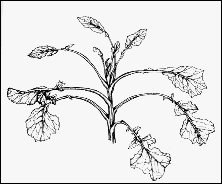 As it is
a member of the Brassica family (of which their are many types in
Britain) it is quite difficult to accurately identify this plant
until it is flowering. Its most familiar characteristics are its
bright yellow flowers and strong smell. There are two types of
rape being tested; winter oilseed rape, which is planted in
August/September, flowers in May/June and is harvested in late
July/mid-August and spring oil seed rape, which is planted in
late March/mid-April, flowers in July and is harvested in early
September. When it is nearly ready to harvest, it has thick stems
with many narrow pods (2-4mm diameter and approx 80mm long). The
pods contain numerous small spherical seeds from which the oil is
pressed.
As it is
a member of the Brassica family (of which their are many types in
Britain) it is quite difficult to accurately identify this plant
until it is flowering. Its most familiar characteristics are its
bright yellow flowers and strong smell. There are two types of
rape being tested; winter oilseed rape, which is planted in
August/September, flowers in May/June and is harvested in late
July/mid-August and spring oil seed rape, which is planted in
late March/mid-April, flowers in July and is harvested in early
September. When it is nearly ready to harvest, it has thick stems
with many narrow pods (2-4mm diameter and approx 80mm long). The
pods contain numerous small spherical seeds from which the oil is
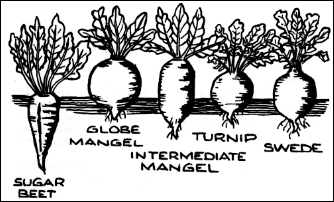
pressed.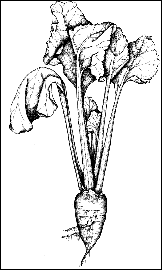 This
plant is related to the beetroot, spinach and swiss chard so go
and have a look at a local allotment for an idea of the leaf
shape you are looking for. In the first year of its life it sends
down a large tap root which is the harvested product. But in some
GM tests (seed amplification trials) it is left over winter or
the root is cut up and replanted, as in the second year the plant
sends out a flower stalk and sets seed. At the later stages of
its development the leaves and the root are quite large and it
cannot easily be pulled out of the ground but must be dug
up.
This
plant is related to the beetroot, spinach and swiss chard so go
and have a look at a local allotment for an idea of the leaf
shape you are looking for. In the first year of its life it sends
down a large tap root which is the harvested product. But in some
GM tests (seed amplification trials) it is left over winter or
the root is cut up and replanted, as in the second year the plant
sends out a flower stalk and sets seed. At the later stages of
its development the leaves and the root are quite large and it
cannot easily be pulled out of the ground but must be dug
up.
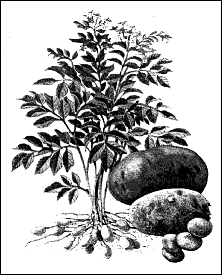 These
are planted late in spring as they are not frost tolerant. The
leaves are usually dark green and slightly hairy, particularly on
the underside. The plants are usually grown in rows on the top of
ridges with earth heaped up on either side of the ridge. Visit an
allotment.
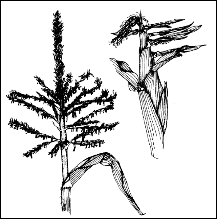
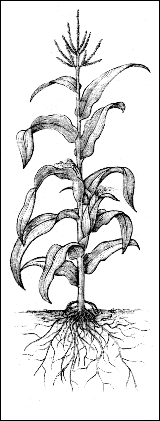
These
are planted late in spring as they are not frost tolerant. The
leaves are usually dark green and slightly hairy, particularly on
the underside. The plants are usually grown in rows on the top of
ridges with earth heaped up on either side of the ridge. Visit an
allotment.It is often difficult to be 100% certain that a trial plot is GM as other types of crop trials may use a similar site layout. One possible test to verify herbicide tolerance of the GM plants would be to apply a small amount of the herbicide, to which the crop is suspected to be tolerant, to a few plants on the trial site and then to check a few days later on their health. We haven't tried this ourselves and you may decide that this use of herbicide is not an appropriate approach in an environmental campaign.
| Crop | Sown | Flowers | Harvested | Notes |
|---|---|---|---|---|
| Spring Oil seed rape | Mar/Apr | July | Early Sept | 10-20cm apart |
| Winter Oil seed rape | Aug/Sept | June | July/Aug | 10-20cm apart |
| Sugar beet | Mar/Apr | Aug | Sept - Jan | 20-50cm apart |
| Maize/Corn | Apr/May | Aug | Sept/Oct | 20cm apart |
| Potatoes | Mar/Apr | Variable | July onwards | 30-75cm apart |
Turning the Tide: A Quaker Programme on Nonviolent Social
Change
 The
programme can help action groups with: developing strategies,
group-building, exploring active nonviolence, communication,
personal nonviolence as preparation for action, nonviolent direct
action training. No group is too large or too small!
The
programme can help action groups with: developing strategies,
group-building, exploring active nonviolence, communication,
personal nonviolence as preparation for action, nonviolent direct
action training. No group is too large or too small!
Contact: Quaker Peace & Service, Friends House, Euston Road, London, NW1 2BJ. Phone 0171 387 3601. Fax: 0171 388 1977.
Turning the Tide Taster sheets:
Click to view the information on the following courses:
Click to download the:
Establish your presence
As soon as you arrive at the action identify yourself to the
senior police officer present and state that you are not there to
disrupt or obstruct anything, merely to observe. If asked, give
your name.
Get close to the action
Get as close to the action as possible without risking arrest or
your safety. If the police block your way or ask you to move,
remind them that you are not obstructing or disrupting anything.
If this does not work speak with the senior officer. Similarly,
with security guards. But remember that while you are committing
no offence, you are still a trespasser and they have the power to
remove you.
Take notes
You should try to take notes all the time and record as much
information as possible (see observer's report form below). Keep
a record every 5 minutes or so - even if nothing is happening. If
an incident (eg. assault or arrest) occurs make a full report.
Record the location and time of any note. All information is
potentially useful, but the following is vital:
Assaults on snowballers: Name of victim; time and location of assault; name, number, description, rank, photograph of assaulter; injuries and how sustained; details of witnesses, including phone numbers. Inform the police of the assault and try to get them to take action. Arrange first aid/ambulance if necessary.
Arrests of snowballers: As above. Also, reason for arrest from police officer or snowballer. Report the arrest to the police liaison person and to a lawyer so that legal representation can be followed up.
Also, note more general things, eg the number of police/guards there are; the types of police/guards and what they are doing; any special equipment - long handled batons, riot gear, horses; TV crews and other media; weather conditions; police treatment of press; incidents of rough handling; attitude of police to you; confiscation of belongings; police tactics; details of police vehicles.
Finally, put the date, your name and signature at the bottom of every page of notes.
Plans
Plans can be very useful to show the location of events. Make
them where appropriate and cross-refer to them in your notes.
Sign and date them.
Cameras
If you use a camera, first take a photograph of the day's
newspaper to date your pictures. Record in your notes the time
and place of any photograph and what it was of.
Stay together
Stay in touch and near any fellow observers at the site, and know
who they are. This is important for a number of reasons: to
provide each other with support and confidence, it will also
allow you to split up tasks between you.
Dealing with the police
If you have problems with the police, be assertive but do not
risk arrest. Note any abuses of power or unreasonable behaviour
(and identities) and report it to the senior police officer. A
formal complaint/legal action/negotiations/publicity can be made
later. If police request your name, give it. You may risk arrest
for police obstruction if not. Note that you have, and record the
identity of the officer.
Dealing with security guards
Similarly, with the guards. However, do not give them your name.
They have no right to have it. Guards have the right to remove
you from the land using reasonable force. They do not have the
police's power of arrest (only citizens' power).
At the end of the day...
Observers reports should be signed and dated and kept safely to
be copied to relevant solicitors and to decontaminators. If you
feel your notes need rewriting for clarity or legibility, do this
straight away (and again sign and date them) so that your updated
notes are admissible in court.
There are 3 main areas of law relevant to observing: aggravated
trespass, obstruction of the highway, and public order.
As long as observers are seen as not being involved in disruptive
trespass they will not be guilty of aggravated trespass. However,
if the police direct people to leave the land, it is better to
obey them. Observers can avoid obstruction of the highway by
making sure they keep to the edge of any highway.
The public order offence which bears most relevance to observers
is obstruction of a police officer. This is a very broadly and
flexibly defined offence: basically, doing anything which makes a
police officers job more difficult, eg. refusing to give your
name if an officer believes you are a witness to an incident,
being too close when they are arresting someone so that you get
in the way. No warning has to be given before an arrest is made
for this offence.
This briefing has been adapted from a Friends of the Earth
briefing. Copies of legal observers report forms are available in
HTML and Adobe
Acrobat format.
Below biohazard sign for photocopying, or press 'shift' and click here to download it.
A5.11.3 The Law and action/legal
observers
As the action will take place on private property anybody present
at the action without authorisation is arguably a trespasser.
This has implications for the legal status of the individuals
observing. The practical implication of trespassing for observers
is that they can be removed by the police or security guards.A5.12 Preparing your
equipment
Essentials
- biohazard warnings
- brightly coloured tape
- heavy duty polythene bags
- heavy duty sticky tape
- protective suits gardening gloves
- over-shoes
- bucket and water
- hand tools
- headscarf or hat
- personal statements
Desirables
- banner and flags
- camera
- camcorder
- symbol of transformation
A5.13 Media
Media contacts are an important part of the campaign. For a
grass-roots view of how the media works, and how to handle them,
read George Monbiot's 'An activist guide to
exploiting the Media'.